Active volcanoes attract travelers with landscapes shaped by fire, ash, and shifting geological forces. From Iceland’s recent eruptions to Indonesia’s smoking calderas and Hawaii’s flowing lava fields, volcano tourism offers extraordinary experiences while requiring careful planning and close attention to environmental safety.
Why Active Volcanoes Have Become Major Travel Destinations
Volcanoes are among the most powerful geological features on Earth, capable of transforming entire landscapes through eruptions, lava flows, ash clouds, and geothermal activity. In recent years, active volcanic regions have become increasingly popular with travelers seeking dramatic natural environments and closer encounters with the forces shaping the planet itself. Destinations such as Iceland, Hawaii, and Indonesia attract visitors not only because of their volcanic scenery but also because eruptions create constantly changing landscapes that can look entirely different from one season to the next. Lava fields, steaming vents, black sand plains, and crater lakes all contribute to environments that feel visually unlike almost anywhere else on Earth. At the same time, volcano tourism requires greater awareness and preparation than many other forms of nature travel because conditions around active craters can change rapidly. Local authorities, scientists, and park services closely monitor volcanic activity in order to balance public access with environmental and personal safety. Travelers drawn to volcanoes are often motivated by curiosity about geology, natural history, and the rare opportunity to witness active planetary processes directly.
Iceland, Hawaii, and Indonesia’s Volcanic Landscapes
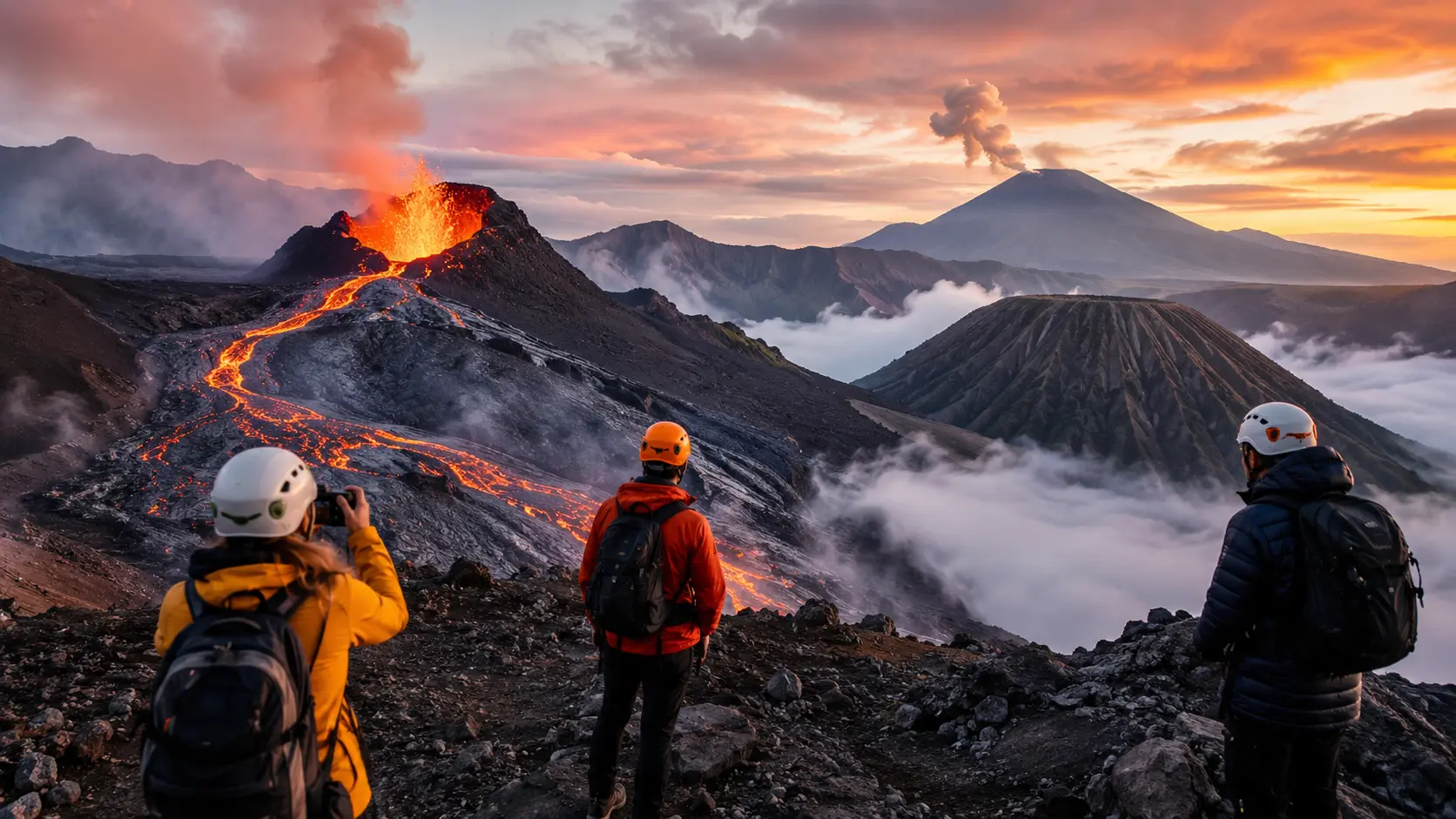
Iceland’s Fagradalsfjall region gained international attention after recent eruptions produced visible lava flows near accessible hiking routes on the Reykjanes Peninsula. The volcanic landscape there combines fresh lava fields, geothermal steam, and rugged coastal scenery shaped by the island’s location along tectonic plate boundaries. In Hawaii, Kilauea remains one of the world’s most closely monitored volcanoes and has influenced the geography and cultural history of the Hawaiian Islands for centuries. Lava activity within Hawai‘i Volcanoes National Park continues to reshape sections of the island through eruptions, volcanic gases, and expanding lava plains. Indonesia’s Mount Bromo presents a different volcanic environment, where travelers cross vast ash-covered terrain before reaching viewpoints overlooking an active crater surrounded by the larger Tengger caldera. Across Indonesia’s volcanic archipelago, mountains shaped by tectonic activity dominate both the landscape and local mythology. Although each destination offers a distinct geological setting, all demonstrate how volcanic regions combine scientific significance, environmental unpredictability, and striking natural scenery that continues evolving over time.
What Visiting an Active Volcano Feels Like
Traveling near an active volcano often feels both awe-inspiring and unpredictable because the environment constantly reminds visitors that the landscape remains geologically active. Sulfur smells, rising steam, vibrating ground, and visible lava fields create an atmosphere very different from conventional mountain or national park tourism. In Iceland and Hawaii, fresh lava formations can still radiate heat long after eruptions slow down, while volcanic gases may drift unpredictably depending on weather and wind conditions. At Mount Bromo, early morning visits frequently involve crossing ash plains and climbing steep crater stairways through fog and volcanic smoke before sunrise illuminates the surrounding caldera. Weather can dramatically affect visibility and access around volcanoes, with clouds, ash, rain, or strong winds quickly altering trail conditions and viewing opportunities. Many travelers describe volcano tourism as humbling because the scale and instability of volcanic landscapes make natural forces feel immediate and physically present. Unlike static geological formations, active volcanoes continue changing through eruptions, tremors, and shifting terrain, meaning no two visits are ever entirely the same.
Essential Safety Considerations Around Active Craters
Safety remains the most important factor when visiting active volcanic areas because conditions can change rapidly even during periods of low activity. Travelers should always follow guidance issued by local authorities, geological agencies, and park services regarding trail closures, eruption alerts, and restricted zones. Volcanic gases can become hazardous near vents and crater rims, particularly in areas with limited airflow or changing wind direction. Stable-looking lava fields may also contain hidden heat pockets or unstable surfaces capable of collapsing under pressure. Proper footwear, weather protection, and awareness of evacuation procedures are especially important in volcanic terrain where sharp rock, ash, and sudden environmental changes are common. Guided tours are strongly recommended in unfamiliar or highly active regions because trained local operators monitor conditions closely and understand the risks associated with specific sites. Travelers should also respect environmental regulations designed to protect fragile volcanic ecosystems and scientific monitoring infrastructure. Visiting active volcanoes safely depends largely on preparation, flexibility, and understanding that access conditions may change quickly in response to natural activity.
Why Volcano Tourism Continues to Grow Worldwide
Volcano tourism continues expanding because it offers travelers a direct encounter with some of the Earth’s most dynamic natural processes. Destinations such as Fagradalsfjall, Kilauea, and Mount Bromo provide experiences shaped by heat, movement, and geological transformation rather than static scenery alone. For many visitors, active volcanic regions create a rare sense of connection to the forces that continue shaping continents, islands, and landscapes across the planet. As monitoring systems and guided tourism infrastructure improve, more travelers are gaining safe access to environments once considered too remote or dangerous for public exploration. When approached responsibly, volcano tourism combines scientific curiosity, environmental awareness, and unforgettable natural spectacle in ways few other destinations can match.